What Informal Training Environments Really Reveal
 Sue Watkins
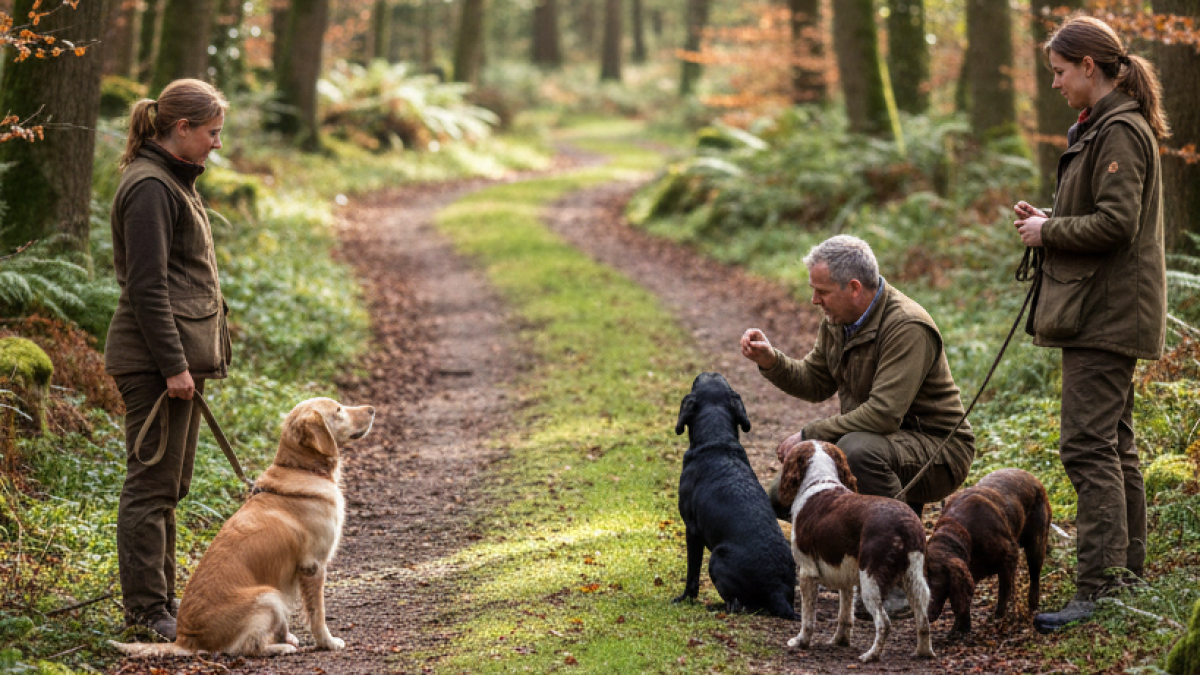
Informal training environments reveal far more about learning, connection, and practice than structured sessions ever can.
What Informal Training Environments Really Reveal
It’s easy to believe training is going well when everything happens in familiar, controlled spaces. The field is known, the exercises are predictable, and expectations are clear. But step outside of that structure and something interesting happens: learning becomes visible.
A recent woodland Stroll & Train session served as a useful reminder of what informal environments can teach us — not just about our dogs, but about our own handling, assumptions, and habits.
The value of these sessions isn’t found in the exercises themselves, but in what they expose.
Familiar Skills Don’t Always Travel Well
One of the most common assumptions handlers make is that once a skill is learned, it is “done”. In reality, skills are highly context-dependent.
A stop whistle, a cast, or a memory retrieve practised in a training field does not automatically translate to:
-
a woodland track,
-
layered scent,
-
moving dogs,
-
social pressure,
-
or the absence of obvious visual markers.
When skills appear to fall apart in these environments, it’s rarely because the dog “can’t do it”. More often, the dog hasn’t practised that skill in that context.
This isn’t regression — it’s a lack of generalisation.
Rusty Handling Is Still Handling
It’s not just dogs that get rusty.
Handlers who haven’t trained in a while often discover that:
-
timing slips,
-
clarity reduces,
-
decision-making feels slower,
-
confidence wobbles.
This can feel uncomfortable, but it’s an important reminder that training is a two-way process. Dogs respond to what we actually do, not what we believe we are doing.
Low-pressure environments are where handlers can notice these things without judgement — and that awareness is the first step back to clarity.
The Illusion of “Knowing Better”
Informal settings have a habit of challenging our assumptions.
Handlers often arrive believing they know:
-
where the retrieve is,
-
how the dog should run it,
-
what the dog should choose.
When things don’t unfold as expected, the instinct is often to intervene, over-handle, or repeat cues unnecessarily. In reality, this is usually the moment to pause, observe, and trust the training that has been done.
Dogs are remarkably good at problem-solving when we allow them the space to do so.
Connection Shows Up Under Pressure
One of the clearest patterns to emerge in informal training is the role of connection.
Dogs that stayed most settled, responsive, and thoughtful were not necessarily the most technically polished. They were the dogs who:
-
checked in naturally,
-
trusted their handler’s information,
-
recovered quickly from mistakes.
Connection doesn’t come from drilling exercises — it comes from consistency, clarity, and shared experience. Informal training reveals this in a way structured sessions often mask.
Adolescence, Maturity, and Changing Dogs
Another benefit of stepping out of routine is seeing dogs as they are now.
Adolescents may struggle more.
Maturing dogs may surprise us.
Experienced dogs may question the rules.
None of this is wrong.
Dogs are not static. Their behaviour reflects age, experience, hormones, recent work, and emotional state. Informal sessions remind us to adjust expectations and support accordingly, rather than forcing dogs to meet a fixed picture in our heads.
Practice Is Not Optional
Perhaps the most important takeaway is a simple one:
We can’t assume competence without practice.
If a skill hasn’t been rehearsed recently, in varied environments, and under different pressures, it’s unreasonable to expect it to hold up. Informal training doesn’t create problems — it reveals the ones that already exist.
And that is a gift.
Why This Matters
Training should prepare dogs and handlers for reality, not just for passing an exercise.
Informal environments:
-
highlight gaps without judgement,
-
encourage thoughtful handling,
-
strengthen relationships,
-
and remind us that learning is ongoing.
They help us work with the dog we have today — not the one we had last week, or the one we hope to have in the future.
And sometimes, the most valuable sessions are the ones that quietly show us where to focus next.