Why We Reward Our Dogs – And Why It’s About So Much More Than Food
 Sue Watkins
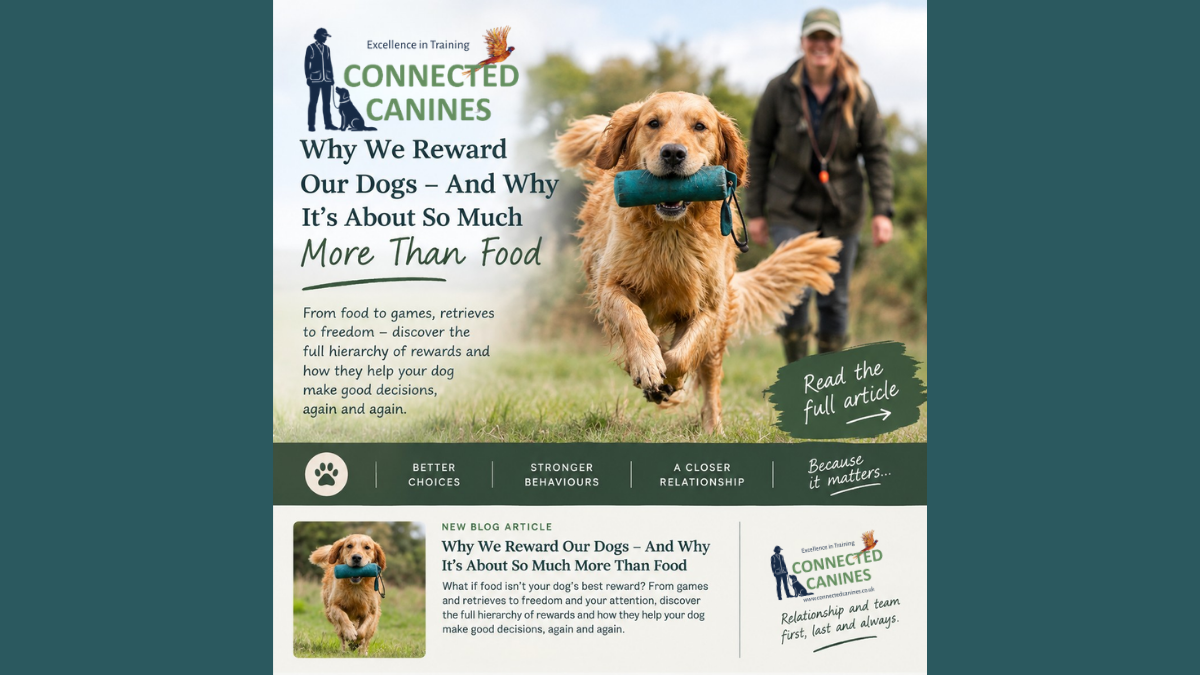
Why we reward our dogs – and why it’s about much more than food.
Why We Reward Our Dogs – And Why It’s About So Much More Than Food
When we talk about dog training, the word reward often seems to immediately translate into one thing: food.
Food can certainly be a fantastic reinforcer. But it is only one of the many ways we can reward our dogs.
Our dogs live in a world full of things they find rewarding. A good game with us, a retrieve, the opportunity to hunt, going for a sniff, exploring, swimming, being released to run, access to another dog, or simply being allowed to continue doing something they enjoy can all be powerful reinforcers.
The important thing is understanding what your dog finds rewarding.
So why do we use reinforcers?
Quite simply, because we want our dogs to repeat good decisions.
When a dog makes a choice that we like and that choice has a worthwhile outcome, the likelihood of that behaviour being repeated increases.
For example, your dog hears their name, turns away from a distraction and looks back at you.
That was a good decision.
If something rewarding happens as a result, your dog learns that paying attention to you in that situation can be worthwhile.
We are not simply giving the dog a treat because they did something we liked.
We are helping them learn:
“That choice worked out well for me.”
And that is an incredibly important part of training.
Over time, we want our dogs to become better at making those choices for themselves.
Reward is much bigger than food
Food is useful because most dogs value it to some degree, it is quick to deliver and we can use it in lots of different training situations.
But imagine having a dog whose greatest reward is retrieving.
If we can use the opportunity to retrieve as reinforcement for another behaviour, why wouldn't we?
Perhaps your dog gives you good attention, walks nicely at heel or responds promptly to a stop cue.
The reward could be:
“Good decision. Now go and retrieve.”
The retrieve itself becomes the reinforcer.
For another dog, a good game with their handler might be incredibly high on the reward hierarchy.
A few seconds of energetic interaction, tug, chasing a toy or simply playing together can be far more valuable than a piece of food.
For another dog, being released to sniff or explore might be the jackpot.
There is no universal reward hierarchy because the hierarchy belongs to the dog.
Think about a hierarchy of rewards
Not every reward has the same value.
Your dog might happily take a piece of their everyday food, but become much more enthusiastic when something particularly tasty appears.
They might like a game with you even more.
They might adore retrieving.
And then, at the top of their personal hierarchy, there might be the opportunity to go and hunt.
That doesn't mean the lower-value rewards aren't useful.
They absolutely are.
It means we should think about matching the value of the reward to the value of the behaviour and the difficulty of the situation.
If we are asking for something easy in a quiet environment, a relatively low-value reward may be perfectly adequate.
If we are asking for a difficult behaviour in the presence of a huge distraction, we may need something considerably more valuable.
Sometimes the environment is the reward
This is particularly useful when working with gundogs.
Rather than constantly trying to compete with the environment, we can sometimes make the environment part of our reinforcement strategy.
Good heelwork might earn a release to hunt.
A good stop might earn the opportunity to retrieve.
Calmness might earn access to the water.
A good response to a cue might mean your dog gets to go and investigate that interesting scent.
The thing the dog wants becomes the reward.
This can be incredibly powerful because we aren't trying to persuade the dog to give up something they desperately want.
Instead, we are teaching them that making good decisions can give them access to the things they want.
Be interesting too
There is another reward that can be incredibly powerful:
you.
A dog that has learned that good things happen when they engage with their handler is often much easier to work with.
That doesn't mean becoming a human entertainment centre every minute of the day.
It means developing a relationship where interacting with you has a long history of positive outcomes.
Sometimes you produce food.
Sometimes you produce a retrieve.
Sometimes you play.
Sometimes you release your dog to do something they enjoy.
Sometimes you simply interact with them.
A good game with you can be extremely high on the reward hierarchy.
And this is one of the reasons I don't want handlers to become overly dependent on food.
Food is a tool.
It isn't the whole toolbox.
Don't become predictable
Dogs are incredibly good at spotting patterns.
If every good behaviour always results in exactly the same reward, delivered in exactly the same way, training can become rather mechanical.
When we are teaching a new behaviour, clarity and consistency are important. But once the dog understands what we are looking for, we can introduce variety.
Perhaps the reward is food.
Next time it might be a game.
Another time it might be a retrieve.
Perhaps it is access to the environment.
Maybe it is simply being released to carry on doing what they were doing.
We aren't trying to keep our dogs guessing about whether reinforcement will happen.
We are building a history that says:
“Engaging with my handler is worthwhile because good things happen when I do.”
That makes us interesting.
And being interesting matters.
Reward the dog you have at that moment
One of the biggest mistakes we can make is assuming that because something was rewarding yesterday, it will automatically be rewarding today.
Dogs aren't machines.
Their emotional state, environment, distractions, tiredness, excitement and previous experiences can all change what they value.
This is why we need to observe our dogs.
Perhaps your dog normally works brilliantly for food but today the environment is much more exciting.
Perhaps your retrieving dog has had a long session and the retrieve has lost some of its value.
Perhaps your dog is over-excited and needs to come back down emotionally before they are capable of learning.
This is where we need to work with the dog we have at that moment.
Training isn't linear.
A wobble isn't necessarily failure.
It is information.
It tells us something about the criteria, the environment, the emotional state of the dog or the value of the reinforcement we are offering.
Reinforcement isn't bribery
There is sometimes a perception that rewarding a dog means bribing them.
It doesn't.
Bribery is about offering something to persuade someone to do something.
Reinforcement is about what happens as a consequence of a behaviour and whether that consequence makes the behaviour more likely to happen again.
Our job is to create useful learning histories.
Dog makes a good choice.
Good things happen.
Dog learns that choice has value.
Dog is more likely to make that choice again.
Over time, we can build reliable behaviours because the dog has learned that those behaviours work.
Build a dog who wants to work with you
Ultimately, I don't want a dog who only works because I have food in my pocket.
I want a dog who has learned that working with me is worthwhile.
A dog who checks in.
A dog who wants to engage.
A dog who understands that responding to my cues can lead to good things happening.
A dog who trusts me.
A dog who knows that sometimes the reward is food, sometimes a game, sometimes a retrieve, sometimes freedom, sometimes access to the environment—and sometimes simply the opportunity to carry on doing something they enjoy.
That is when reinforcement becomes much more than a training technique.
It becomes part of the relationship.
And for me, that's what training is really about.
Relationship and team first, last and always.