Reading the Ground: How Scent, Weather, and Terrain Influence Your Gundog’s Work
 Sue Watkins
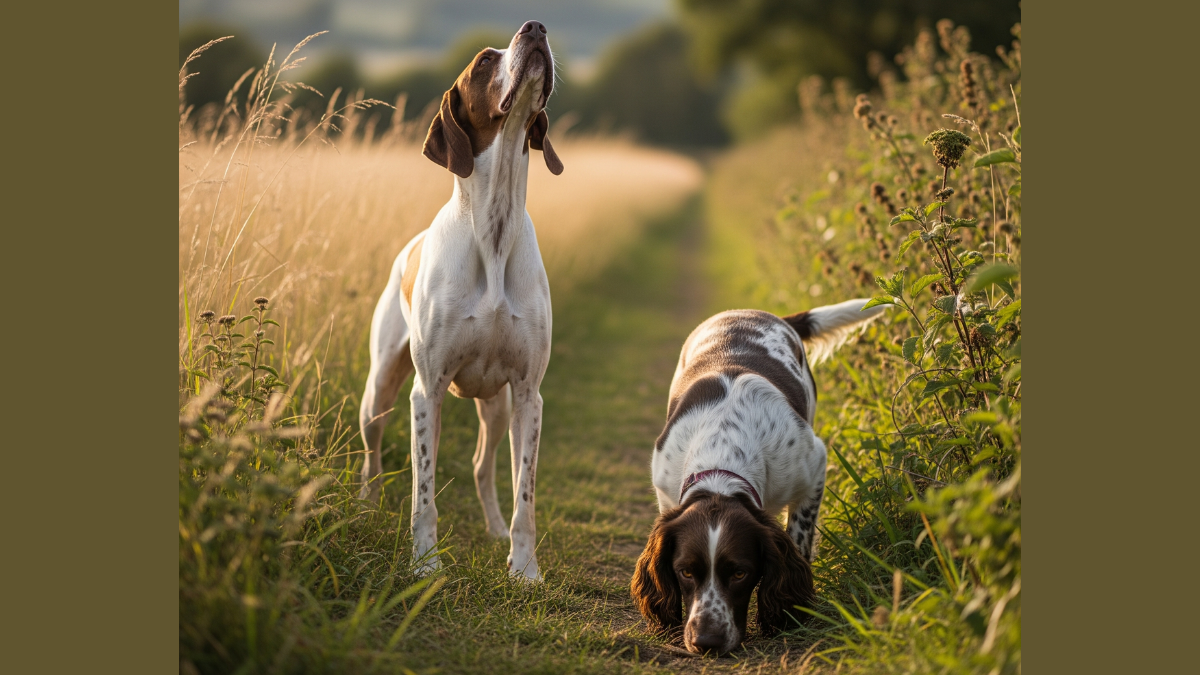
Learn how scent, weather, and terrain shape your gundog’s work — and how different breeds read the ground in their own unique way.
Reading the Ground: How Scent, Weather, and Terrain Influence Your Gundog’s Work
When we train or work our gundogs, we often think about the visible elements — where the dummy lands, how straight the line is, or whether our stop cue is followed promptly. But our dogs are tuned into something invisible: the scent picture.
The ground and air are full of information. Every breeze, temperature change, and shift in terrain alters how scent travels. To work effectively with our dogs, we need to understand what they’re sensing — and how different types of gundogs instinctively interpret that information.
Scent: The Invisible Map
For a gundog, scent is the story of what has happened on that piece of land. It’s more than just “bird here” — it’s when the bird or any other animal passed, what direction it went, how fast it moved, and even its stress level.
We might see “empty” ground, but to a dog, that same field could be a bustling high street full of messages.
Weather and Scent Flow
Weather plays a huge role in how easily scent can be found.
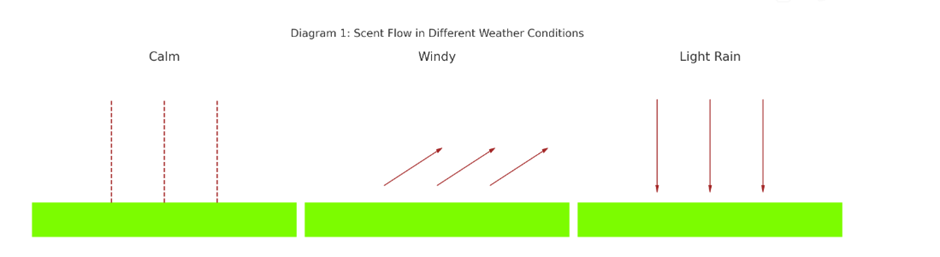
Table: How Weather Influences Scent
Condition |
Scent Behaviour |
What You Might See From the Dog |
Training Tip |
Cold & Damp |
Scent clings to ground and lingers |
Confident, nose-down work |
Great for introducing young dogs to hunting |
Hot & Dry |
Scent dissipates quickly |
More casting and searching, less direct tracking |
Keep sessions short and rewards high |
Windy |
Scent blown off course |
Dog works crosswind or zig-zags to intercept |
Work across wind to help the dog find the scent cone |
Light Rain |
Scent brought down to ground level |
Dogs may track more directly |
Good for line work |
Heavy Rain |
Scent washed away |
Dog appears to “lose” the trail |
Avoid overly complex retrieves |
Diagram 1: Scent Flow in Different Weather Conditions
Terrain: How the Ground Holds Scent
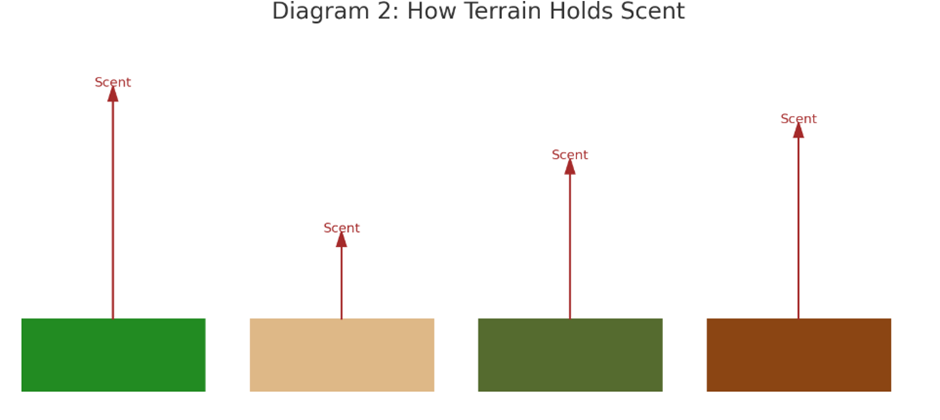
Different surfaces absorb and hold scent differently:
- Long grass — traps scent close to the dog’s nose, making hunting easier.
- Bare earth — scent dissipates quickly, requiring the dog to work harder.
- Woodland leaf litter — can hold scent but also mask it under layers.
- Heather/bracken — scent hangs in the vegetation; dogs may work more with head up.
How Different Gundog Types Work the Ground
Not all gundogs interpret scent the same way. Breed purpose and instinct shape their natural approach.
Retrievers
- Typically sent to a known fall area.
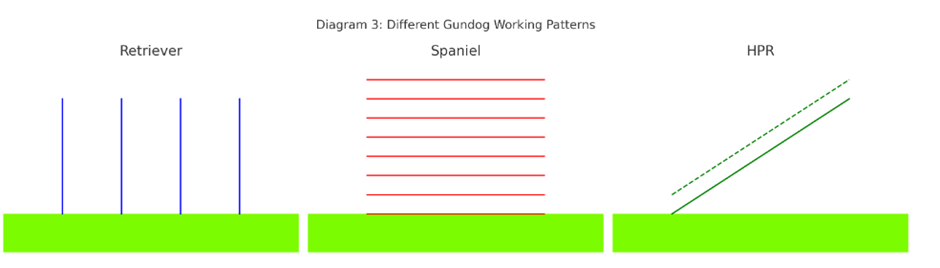
- Work more systematically in straight lines.
- Many (especially Labradors) are ground-scent specialists, excelling in cool, damp conditions where scent clings low.
- Some, such as flat coated retrievers and golden retrievers, are natural air scenters, thriving in conditions that lift scent, like a light breeze over open ground or light rain.
Spaniels
- Designed for close, thorough ground coverage.
- Work in a tight quartering pattern, covering every inch of ground.
- Switch between nose-down ground scenting and head-up air scenting depending on conditions.
- In training: focus on controlling speed without dampening enthusiasm.
HPRs (Hunt, Point, Retrieve breeds)
- Combine air scenting and ground scenting.
- Work wider areas with an open hunting pattern.
- Tend to lock on to air scent, then close in and point before moving in.
- In training: benefit from varied terrain to develop both close and wide search skills.
Training With Scent in Mind
Instead of getting frustrated when a dog deviates from the “plan,” try working with the scent picture they’re following:
- Vary the training ground — don’t always train in the same field.
- Work in all weather — so your dog learns to adapt to different scent pictures.
- Notice body language — tail speed, head position, pace changes — they’re clues.
- Practise crosswind and downwind work — teach your dog how to find the scent cone.
- Manage expectations — sometimes conditions mean scent simply isn’t available.
The Takeaway
When we understand scent, weather, and terrain, we stop expecting our dogs to work in a vacuum. We learn to interpret their choices and adapt our training.
Different gundogs have different styles, but all are reading the same invisible map — one we can never fully see but can learn to respect. By reading the ground alongside them, we strengthen our working partnership and our trust.